Saturday, June 30, 2012

Thoughts on Obedience, Part I


Benedict begins his Rule with the word: 'Listen', a listening with 'the ear of the heart'.  To listen (obaudire) is to obey, and obedience is the third promise which a Benedictine professes.  It is, firstly, a call to hear and respond to the word of God.  The word is most explicit in the Word made flesh, Jesus Christ, and in his good news.  It is to him that Benedict summons his followrs to return by the 'labor of obedience' in order to fight for and establish God's reign over the territory of the human heart.

from The Gift of Saint Benedict
introduced by Verna A. Holyhead SGS

Friday, June 29, 2012

...if we stay near to God


A hermit pointed out that a person near the emperor is safe from harm.  "Satan cannot harm us if we stay near God.  It is because we frequently become vicitms of pride that it is easy for the emeny to lead our miserable souls into physical passion and humiliation."

By Way of the Desert, 365 Daily Readings
compiled and modernized by Bernard Bangley

Thursday, June 28, 2012

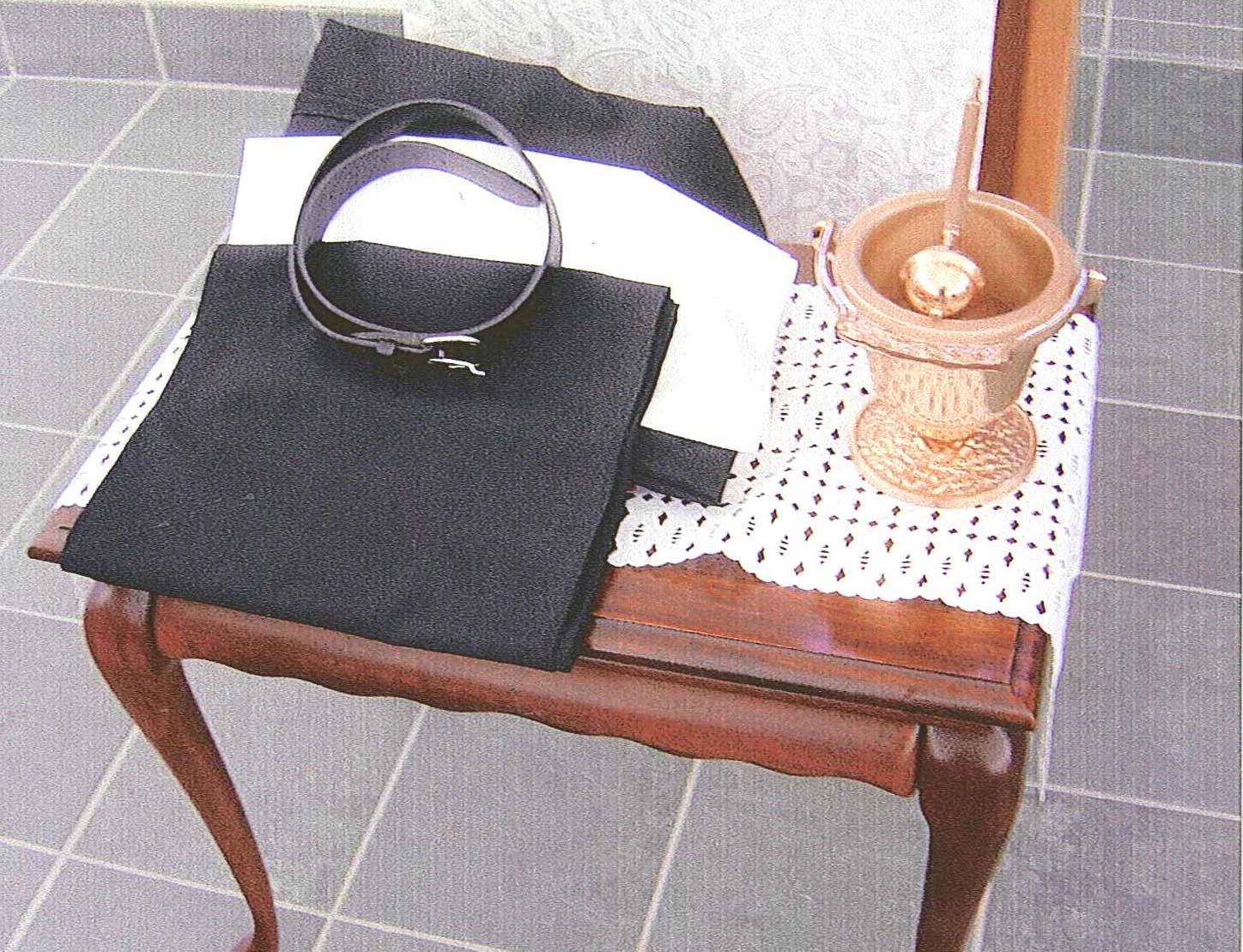
Our Habit

The tunic, scapular, cincture and veil to be blessed for a new novice.

One of the more common questions that arise is "What exactly are the various parts of your habit?"  The habit is made up of several basic elements:  tunic, scapular, cincture (or leather belt), coif and veil.

The tunic is the main garment of the habit.  It is a long sleeved, floor length garment, belted at the waist. 

The scapular consists of two panels of fabric joined at the shoulder that is the same length as the tunic.  Originally St. Benedict thought of this garment for work purposes, as an apron.  

The coif (some also call this a wimple or guimpe), is the white material covering a nun’s head and throat and has a rounded collar.  For the early morning Offices and Holy Mass we wear a coif that is pleated.  It is approximately a yard of starched linen.  During the day, we have a simple coif that is sewn of wash and wear fabric and much easier to maintain. 

The veil is worn over the coif.  A novice wears white veil, a black veil is worn by a nun in temporary vows, a nun in solmen vows wears a black veil with white liner, it is also referred to as “double” veil.

Nuns in solemn vows also wear a cuculla, or choir robe.  It has wide, deep sleeves, and pleats vertical pleats or folds that hang the full length from the shoulders to the floor.  This is worn over the tunic and scapular.  We wear our cacullas on Sundays and Solemnities, except during the summer months due to the high heat and humidity of southwestern Pennsylvania.

Wednesday, June 27, 2012

Mary's Consent


Salvation would be God's gift, but it had to be accepted.  It had been lost by the first parents of the human race, mysteriously described in the event of the Book of Genesis, and it would be recovered by the free consent of the human being who would accept the absolute salvation of God.

It is fruitful to meditate on the fact that this event took place in the most silent of ways.  Just as no one had ever head the explosion that was the "big bang," just as no one hear the cosmic events in the sky because they go on in a world where there are no ears to hear them, so also the event that would be the re-creation of the world took place in the absolute silence of the inner being of a single human.

The Gospel of St. Luke describes this event which is the second creation of the world.  It is as mysterious and spell-binding, as utterly overpowering to the human intellect as the great explosion at the beginning of creation.  But this time it includes the freedom of the human will.  The human will had once chosen evil, now it would choose good.

from Quiet Moments with Benedict Groeschel, 120 Readings

Tuesday, June 26, 2012

Prayer to Know One's Vocation


O blessed St. Walburga,
Who heard the call
of the Heavenly Bridegroom
in the depths of your heart,
intercede now with that same
Heavenly Bridegroom
that I may know
to what vocation He is calling me.
If my vocation be to
the consecrated life,
may He fill my heart with the
same love, joy, peace that you knew
in serving and following Him.
I ask this through Christ our Lord. Amen.

Monday, June 25, 2012

The Sweetness of the Divine Will...


When shall it be that we shall taste the sweetness
of the Divine Will in all that happens to us,
considering in everything only His good pleasure,
by whom it is certain that adversity is sent
with as much love as prosperity,
and as much for our good?
When shall we cast ourselves undeservedly
into the arms of our most loving Father in Heaven,
leaving to Him the care of ourselves and of our affairs,
and reserving only the desire of pleasing Him,
and of serving Him well in all that we can?

~ St. Jane Frances de Chantal

Sunday, June 24, 2012

The Heart of Jesus Our Model - Part II


Our Lord joins the lesson of meekness to that of humility precisely because the immediate foundation of meekness is humility.  It takes only a small amount of pride, of self-love, of attachment to our own way of seeing or doing things to mkae us unable to stand opposition.  Then in the face of the shocks inevitably arising from the common life, we lose, to a greater or lesser extent, our serenity, our interior and exterior peace.  If serenity is lost, calmness of judgment is also lost; therfore, we are no longer able to see clearly the divine light showing us wich path to follow in order to give Our Lord what He is asking of us.  Our soul wavers, loses its vigor, and allows itself to be ruled somewhat by passion.  As long as any traces of pride and self-love remain in us, there will always occur circumstances in which we will lose some of our control and self-mastery; consequently, we shall lack meekness.  to profit by the lesson of the Heart of Jesus, and to model our heart on His, we must work assiduously to uproot every trace of pride and self-love.  It is a task to which we must give our attention day by day, always beginning again, and never allowing ourselves to be discouraged by the constant recurrence of the attractions and resentments of our "ego."  We can only win this battle by never giving up the struggle.

To arouse our courage, let us remind ourselves that our strivings are not only good for our own soul but useful also to others, for, as Pius XI says, "the more we have sacrificed our self-love and passions, the more abundant will be the fruits of propitiation and expiation which we shall reap for ourselves and for others" (Miserentissimus Redemptor).  The battle against self-love and the practie of humility are both part of the program of a soul consecrated to the Sacred Heart, of one who has offered itself to Him asa victim of reparation.

from Divine Intimacy
by Father Gabriel of St. Mary Magdalen, OCD